Tuesday, 24 September 2013


WHAT THEY REALLY MEAN - A free guide to what politicians actually mean when they do media interviews. We are well into the season of party conferences. The broadcast media seem obsessed with the idea that the normal populations gives a s*** about these expensive and self-congratulatory junkets. Turn on any half decent radio station (Holbeach FM - that includes you out, sorry) and you will be regaled with wall-to-wall interviews with creatures who have scuttled out from under some party political stone, to blink in the daylight. They lie. They dissemble. They avoid answering questions. They use a parallel language which seems to make sense, but when analysed, signifies nothing. Next time you listen to one of these charlatans, have this handy guide ready, so you can understand what is really being said.

(1)  "Firstly, I'd like to....." If a politician begins an answer like this, then switch off immediately. It means they have been expensively coached by some PR 'expert', who may have scraped a 2:2 in Media Studies at the University of Chelmsford. It also means they have no intention of answering any questions, but have an agenda decided for them by their party special advisors.

(2)  "This is a conversation that we need to have with......" This means that one part of the party is daggers drawn with another, and rather than implying a dialogue, it translates as," I'm going to talk, and those bas****s are going to listen."

(3)  "We need to move forward..." This is a sure sign that some horrendous dirt from a few months ago has been uncovered by the press, but we have just invented a new scheme to give free incontinence pads to gay Albanian pensioners in order to deflect attention from the scandal.

(4)  This is in the same category as (4) When some official says, "Lessons have been learned since...''(30 teenage girls groomed by Pakistani rapists, 18 old people died through neglect and malnutrition in a care home, a delusional psychopath is released into the community by Health 'professionals' and then stabs to death a 32 year old father of two on an Underground platform...) What this means is, " S**t happens. The managers concerned have all been moved sideways, sent on a two-day re-evaluation course, or have been given a generous pension and been re-employed by G4S."

(5)  "I have every respect for..." This means that the person under discussion is a thieving, unscrupulous, child-abusing, moronic retard who, were they to be on fire outside the 99p shop, the interviewee would not p*ss on the flames.

(6)  "The voters have spoken, and I hope the winning candidate will continue to serve the community as I have tried to do." A nice way of saying, "So, I spend four years of my life listening to pathetic moans about dogshit on the pavement, opening bloody fetes and picking up cans of Fosters and used condoms from the village green, and they vote me out? The ungrateful,short-sighted retards deserve all they get!"

Wednesday, 21 August 2013


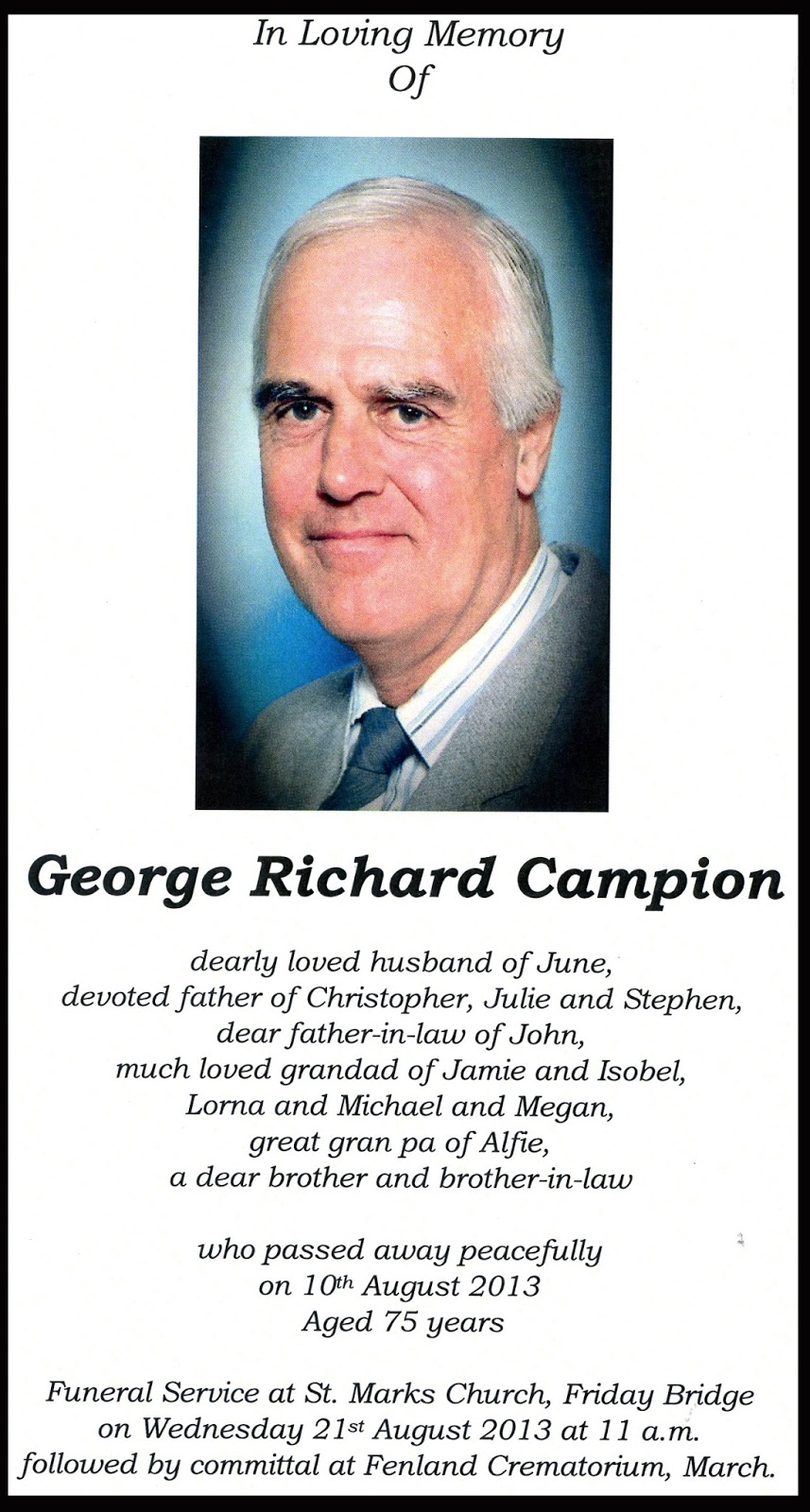
WE SAID GOODBYE to George today. Donning my ancient shiny suit, which hadn't seen service since the last funeral, I tried to remember how to tie a Windsor knot. Retirement has many challenges, but doing the simple repetitive motions which were second nature for every day of forty years of casting artificial pearls before real swine, now has to be thought about. Tie knotted, wife dressed, perfumed and complimented we set off for Friday Bridge. For non-Wisbech folk, there is no bridge, and no-one knows where the Friday comes from, but be that as it may, it has an amazing Victorian church, which sits at an alarming angle, as it appears be sinking slowly into the Fen. Were it in Italy, it would be surrounded by Japanese tourists and the subject of a thousand postcards. Joking aside, there was a poignant symmetry, because it was in this very church that June and George were married in 1965.

The church was full of folk, mostly of 'a certain age', but there were also grateful former pupils, some now with children of their own. The sun shone through the clear glass windows, and a captive butterfly fluttered against one of the diamond panes. Then came the family, and George himself, but from the congregation there were more smiles than tears, because after the organist had worked her way through the usual funeral fare, we heard the unmistakeable strains of The Harry Lime Theme, from The Third Man. George was having a final chuckle, and made sure that at least some of our sadness was blown away by his enduring sense of humour.

We sang Crimond, and All Things Bright And Beautiful, and joined in with prayers and invocations which were lucid and full of meaning, but reassuringly traditional. To the long forgotten strains of 'You Are My Heart's Delight' George was borne away by the pall-bearers and his family, and we emerged into the mid-day sunshine to chat, gossip and catch up with old acquaintances. A fine man had passed from us, but there was an unspoken agreement his that here was a man who, by his compassion, decency and good humour, left the world in a better state than when he came into it.


Tuesday, 13 August 2013


This week, one of Wisbech's finest has passed from us. George Campion, teacher, football man, friend - and intrepid cyclist - has died at the age of 75. I first met him when my wife and he were colleagues at the short lived, curious, but always entertaining private school - St Paul's Gorefield. It was a school which set out to provide what might be called niche education for those youngsters who, for whatever reason, were finding things tough at larger schools. I have to say that although many of the children were delightful, there was always a slightly 'Decline and Fall' atmosphere about the place, and George regarded the school - and its two proprietors - with a kind of cynical benevolence. Eventually, when I got a call at work from my wife one Friday morning in December, to say that the proprietor had locked the school and fired all the staff. It was  rather a sad end to what had seemed a bright and optimistic enterprise. George helped my wife run a kind of home school at our house for some of the children for the remainder of that Christmas term. Over the next two years or so, George and my wife had to go to the small claims court to get their unpaid salaries, but eventually, after putting charges on the proprietor's house, honour was satisfied, and the money was paid.

Meanwhile, George had achieved his fifteen minutes of fame by being at the centre of Sandwichgate - when Wisbech Town FC, of which George was chairman, got into major trouble for not providing proper sandwiches for a visiting tea. There was much mirth drummed up by the national media, and the club were eventually suspended from the league, but as with all mini dramas, everyone moved on and the affair was consigned to the footnotes of Wisbech history.

My third son, who now has a Masters' Degree, was a rather eccentric and fragile lad when he was little, and after one too many episodes of him coming home from primary School in tears, we sent him to St Paul's. He developed an instant bond with George and as he grew up he came to regard George as a kind of surrogate grandfather. He became a passionate follower of Wisbech Town, often used to help with bits and pieces like selling programmes, and was encouraged by George to take his referees' badges and become involved with the sport at grass roots level. He will be taking George's passing particularly hard.

Although George had a good decade on me, age-wise, we both were educated at long since defunct Teacher Training Colleges. We were both proud bearers of that archaic award, the Certification In Education, or Cert Ed for short. We shared a distrust of modern teaching methods, but George had an infinite faith in the inherent goodness of young people, including some of the exludees from local schools, for whom visits from George were their only contact with learning. He was also much in demand by the parents of less troubled souls, who wanted to help their children with grammar school entrance exams, or to untangle the complexities of GCSE maths.

He was a man of infinite kindness. When my boys were youngsters, we didn't always have a great deal of money to spend on extras as a family, as my wife had chosen not to dance the Maternity Leave Tango, but instead put her career on hold while she brought the boys up herself. George had a static caravan up near Heacham, and let Diane and the boys use it whenever they felt the need to get away for a few days. He would take no payment, but would gratefully accept a bottle of his favourite Southern Comfort for his trouble.

It could be said of George that he was a simple man, but a man who saw and understood the complexities of life, and that he was a man of great learning, but one who wore his learning lightly. He was a familiar figure, pottering along the Lynn Road and about town on his ancient bicycle. We met each other infrequently over the last few years, as my boys had all left home to seek their fame and fortune elsewhere. I last bumped into him in the Market Place, me on my bike and he on his. His first question was always, "How are the boys..?" I was always pleased to give him a positive reply, but I just wish now that I had been gifted with the foresight to add the words, "Thanks in no small measure to you, George."


Thursday, 25 July 2013


THE KILLING OF JOHN AUGER


The initial legal proceedings took place at Taverham Magistrates' Court, and the three men were represented by Mr Kenneth Land (Southwell, Dennis and Land) When the case was moved to Terrington Magistrates' Court, a new element entered the proceedings. It became apparent that witnesses were being threatened, and here there is a distinct similarity to the events surrounding the trial of Tony Martin, over thirty years later. Wallace Virgo said, "Members of the public who have come forward as witnesses in this case have been threatened and intimidated." On March 31st, the men were remanded after threats to intimidate witnesses at Terrington St Clement Magistrates Court. 

The former court at Terrington St Clement

Later in the proceedings, Kenneth Holman of 134 Lynn Road was called to the witness box, but refused to take the oath. He later returned, and gave evidence. He was  declared to be a hostile witness. On April 20th, Collins said, after unsuccessfully applying for bail, "I have had time to think about this. As far as I am concerned, I know nothing about anyone being threatened, and I think the Superintendent should not have said that"
The eventual trial took place at Hertford Assizes, where the Presiding Judge was Mr Justice Glyn-Jones , who had represented the parents at the Aberfan enquiry Other people declared to be hostile witnesses were Valerie June Foley, who was asked if she lived at 24 Guild Road, but denied it. She refused to look at a statement she had previously made to the police. Friends of the suspects leapt to their defence. Warden said he had been to the fair, went to his parents' home, watched TV and then fell asleep in the chair. John Richard Warden, of 33 Bath Road, said he had come home to find his son asleep in the chair. Grace Evelyn Warden corroborated the story. At the time David Warden was living with Sandra Setchfield, but was always "popping in and out." At the trial, Mr Michael White, the landlord of The Bowling Green said that Cooper and Warden had been in there drinking, but did not return as they usually did before closing time. They had been whispering, and talking to each other outside. Cooper claimed that on the night of the murder he was trying to break into a garage in Lynn Road, Wisbech, to steal cigarettes. Due to give evidence, Kenneth Osborne Holman failed to arrive, and a warrant was issued for his arrest. Holman was widely believed to have been intimidated into silence and he was later sentenced to three months in jail. Cooper was known as a local thief, had been in prison, but had no record of violence.

Against a background of intimidation, local loyalties and the fear that hardened criminals inspired amongst Waterlees residents, there were eventual convictions. The verdict was that the men were guilty of manslaughter. Glyn Jones said that it was "One of the worst cases of manslaughter ever to come before me." Cooper was judged to be the planner and was sentenced to fifteen years for manslaughter and five for burglary, to run concurrently. Warden, who used the violence received twelve and five, as did Collins. No-one, apart from the criminals themselves, has ever suggested that there was a miscarriage of justice in 1967. In his statements, Warden seemed to be saying that yes, he had done it, but the police would be hard pushed to prove anything, as the killers had been meticulous about leaving no traces.

And yet, and yet. In 1977, Commander Wallace Virgo, head of the Serious Crime Squad, was convicted of corruption, and sent to jail . As the ensuing corruption investigations widened, the obscene publications squad was replaced in its entirety with a new group of officers drawn from the uniformed branch, and in all over twenty detectives were dismissed or required to resign. When the cases ultimately came to trial in 1977 the presiding judge Mr Justice Mars-Jones summarised those involved as having engaged in "corruption on a scale which beggars description" Ten years earlier, had the case-hardened and confident London detectives arrived in the relative backwater of the Fens and 'done a job' on some local men who were certainly career petty criminals, but not very bright? The jury's verdict was certainly unequivocal, and the three men were perhaps lucky to have only been convicted of manslaughter. The last executions in mainland Britain had been in August 1964, so the three were never going to face the death penalty, but they were certainly reprieved from a much longer life sentence. The killing of John Auger is by no means an unsolved crime, but the suspicion remains that there were others involved who did not face justice.

Sunday, 21 July 2013


THE KILLING OF JOHN AUGER (part 2)

THE INITIAL INVESTIGATION was headed by Detective Superintendent Reginald Lester of the Norfolk County Criminal Investigation Dept, and after Mr Auger's grey Volkswagen truck, registration number HPW 327D had been found abandoned, and frogmen had searched the port area for the missing safe, the killing made headlines in the major national newspapers. 
 
JOHN AUGER'S VW TRUCK (top picture)


The safe was eventually found in a ditch beside Meadowgate Lane. The tragic irony, and a testament to the stupidity of the criminals, was that the safe had been virtually empty, while the thieves had ignored Auger's immensely valuable collection of porcelain

THE SAFE IS FOUND BESIDE MEADOWGATE LANE
WITHIN DAYS the investigation into Auger's death was moved 'upstairs'. None other than Detective Superintendent Wallace Virgo, of Scotland Yard, was brought in to spearhead the search for the killers. At this point in the investigation, there were over sixty officers involved in the search for the perpetrators. Days passed, as the police rounded up 'the usual suspects'. At first, based on the initial eyewitness accounts, police were looking for five men, and the search was beginning to focus on the Waterlees area of Wisbech. Two weeks after the death of Mr Auger, the police swooped.
David Warden, of Guild Road Wisbech, was arrested in a betting shop in Hill Street on March 23rd, and said, "I suppose somebody has squealed. I was there, but you will have a job to make this one stick" He is also alleged to have said,"You will look sorry if you've got the wrong Warden." and "Even if you are from the Yard, you won't prove anything. I was there....but there was nothing left behind and you know it."
Patrick Joseph  Collins had been arrested at his parents' home in Mosely, Birmingham. He said, "If only I could turn the clock back I would not have done what has been done. I will tell them about it when I get to Wisbech." When arrested, he had tried to hide under the bed, and was told he was being arrested for housebreaking. He said, "Thank God: I thought you had come about something else" He said he had been at Outwell, but denied doing "the thumping" The third man arrested was Barrie Paul Cooper, who lived with his schoolteacher mother at the School House, Sutton St Edmund.


ONE OF THE SUSPECTS IS DRIVEN AWAY BY POLICE


TO BE CONTINUED

Saturday, 20 July 2013


WISBECH HAS HAD ITS FAIR SHARE OF MURDERS.  Some might say more than its fair share. In recent times, we have had, in no particular order, Una Crown, Virginja Jurkiene, Jolanta Dumciuviene, Dainus Kigas, Christopher Garford, Erikas Ulinskas, Alisa Dmitrijeva, Emily Bates and, if you include manslaughter, Fred Barras. For a town with a population of 20,000 or so, this might seem excessive, and you are free to draw your own conclusions from the list of names. But Wisbech was not always an idyllic rural paradise, despite the rosy memories of some residents. In 1967, a brutal killing happened in the area which, although the perpetrators were eventually convicted of manslaughter, achieved national notoriety, and resulted in the case being handled by top detectives from Scotland Yard.

DIAL HOUSE, OUTWELL
On the night of March 10th, 1967, Dial House, an old, sprawling farmhouse in Outwell, was invaded by three men wearing stockings and balaclavas over their faces. The owner, John 'Robbie' Auger. a wealthy fruit farmer, was beaten to death with an iron bar, and his safe was dragged out, and put into his truck, which the killers drove away. Auger's wife had been bound and gagged during the attack, and the crime was discovered when Auger's daughter Audrey, aged 33, returned home to find her stricken father and helpless mother. She alerted a neighbour, saying, "Come quickly, Dad's been attacked.." 

TO BE CONTINUED